The emergence of 4D Printing

We’ve all heard about 3D printing and its advantages, and many of us have experienced 3D printing techniques in our job roles, but what exactly is 4D printing? Talk of this emerging form of printing came about when Skylar Tibbits, a famous architect began referring to time when speaking of the fourth dimension. So, he like many others believe that 4D printing will be defined as technology that allows us to print objects that then reshape themselves or self-assemble over time. We are years away from this technology but even talking about it makes us excited. Imagine the capabilities. You could construct something that has been designed to adapt and transform over time. There are many expanding materials and deformations that can be used in this technology, and I’m sure we’ll hear more about it over the coming months and years. Who knows when we’ll be hearing about 5D printing.

How 3D Printers Could Revolutionise Production

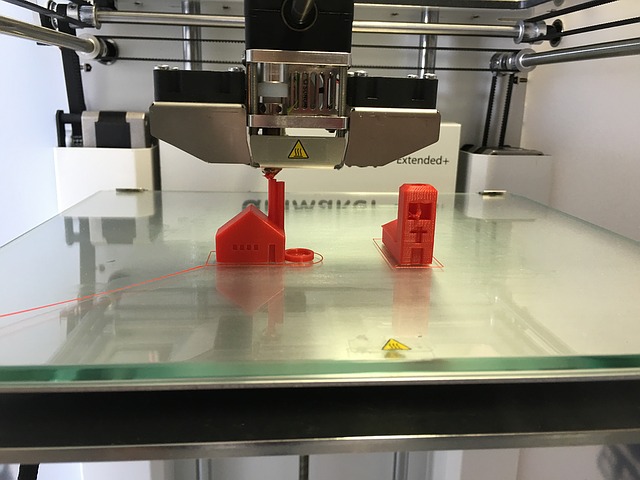
One of the most interesting areas for manufacturing in recent years is the advent of the 3D printer. While the technology is still in its infancy, the potential they offer businesses and private individuals is the ability to make a tremendous breadth of products all from one production machine.

Over the last decade, one could say that a bit of a cottage industry has arisen from among the users of 3D printers. Within this industry, you see a massive exchange of product schematics, which somebody just needs to put into their system and, hey-presto, they’ve made a working product. perhaps most famously, plans for creating an entirely plastic gun were released to the public.

What this means for businesses is the ability to create a wider range of products with a much smaller investment in their production machines is within their grasp for the first time. While the technology is certainly still developing and under serious limitations, its still encouraging.

Description for Air Compressors

Air compressors are appliances responsible for converting power to potential energy. These devices force air into a storage tank thus increasing the tank pressure. The devices eventually shut off when pressure reaches the upper limit. The stored air which is compressed is kept in the tank to be used later. Air compressed by these devices contains energy that can be utilised in a number of ways. This is possible by harnessing the air’s kinetic energy as it is being discharged. The storage tank depressurises when the air is released and once the pressure reaches its limit, re-pressurising of the tank takes place. Air compressor automatically turns on to force air again until the tank pressure attains its upper limit. To know how much reserved compressed air is available, you check the tanks gallon size.
The devices operate on an electric motor, a gasoline or a diesel engine. Their power is measured in CFM (cubic feet of air per minute) and HP (Horsepower). Compressors powered by electricity are used widely in garages, production and workshops that have a permanent source of electricity. Most of them are 230-240 Volt or 110-120 Volts. The devices come in “twin tank”, “vertical”, “pancake” and “horizontal” shapes. Gasoline or diesel compressors are essential in remote areas that do not have an access to electricity. These need exhaust gases ventilation and are noisy. Compressors can be portable or stationary. This is determined by their size and purpose.
Types of Displacement.
There are two designs made as per the operation principle. The Turbo and Rotary screw compressor. In the two styles, many methods of air compression are used. These are partitioned into rotor-dynamic or positive-displacement kinds.
1. Rotor-Dynamic Displacement
These types of compressors have a component which transmit its kinetic energy to the air. The kinetic energy is then changed into pressure energy. A spinning component known as impeller generates centrifugal force which pressurise air by accelerating and decelerating air that has been captured. Axial and centrifugal compressors are among the rotor-dynamic displacement machines.
2. Positive-displacement
The working of these types is different. They force air into a chamber with decreased volume to compress air. General positive-displacement compressors include the Rotary screw, Vane and Piston type air compressors.
Operation
Air compressors need to cool because of adiabatic heating. Cooling of these devices can be facilitated by the use of water or air. Some of the machines like the rotary kind may be cooled using oil. Atmospheric variations determine the appliances cooling.
Uses
There are numerous uses of air compressors. Some of the general applications of the devices include:
• Filling gas cylinders
• Filling tires
• Supplying moderate-pressure clean air for running pneumatic HVAC control system valves in schools and offices buildings.
• Supplying a submerged surface supplied diver with moderate-pressure clean air
• Providing large-scale industrial processes with moderate-pressure air in large amounts
• Supplying power pneumatic tools like jackhammers with large amounts of moderate-pressure air
Oil-less and oil-lubed are the two types of air compressor pumps used in air compressors. The oil-less pumps produces better quality air but has some limitations. They do not last long and are louder and more expensive.

Using Automation To Create Smart Factories

In today’s fast-paced society the manufacturing process from design to development and distribution needs to change to produce flexible products, as well as keeping up with the supply and demand of mass customisation. This can be achieved through the use of smart factories that have incorporated automated systems into every aspect of the business.

What this means is that machines can be reprogrammed automatically inline with the next generation of customisable products that the customer have requested, and subsequently have a faster production time.

Using this approach businesses can cut the costs greatly and the human workforce becomes significantly less; human error no longer factors into the design process and each unit is produced through a precisely calibrated system according to the exact specifications of the product.

Electric Cars & Charging Stations

Electric cars are a great idea for use in a city, but they are not good for long journeys because the lithium Ion battery only allows for a range of up-to 60 miles before the car needs recharging. Normally recharging can take from 6 – 8 hours to charge and that’s just not convenient for long journeys; though that being said if you working within a 60 mile radius you can charge your car during the day when you are at work, but you have to work in a city that has the allocated parking for charging your car during the day.

What if you work in an area that does not have a place you can park your car all day to charge, or you have to drive more than 60 miles? Do you bring a spare battery and swap them out? Well even if you did, you would still have to wait for the battery to cool down before you took it out of the car, and then fiddle about swapping the battery’s; there are some cars out there that have a backup battery included with the main battery inside the section of the car where the main battery is, but they still have to be charged after use?

A good solution is to use a hybrid petrol/diesel and electric hybrid, which will travel many miles using the fuel, and will be economical and switch to the electric battery power when in the cities and towns to save money on fuel. But the car is still using combustible fossil fuels and adding harsh chemicals to the environment from the exhaust system, therefore it’s not a viable green technology for the future.

So how do we combat the problem we currently face with electric cars, static charging stations, limited availability of charging stations, and the time it takes to charge the battery’s? The answer is simple, we make use of the new transparent solar cell coating that can be applied to any surface and apply it to the windows of the electric vehicles so they are able to charge as they drive; in addition to this we can use the electromagnetic harvester technology that gathers free electricity from thin air when the weather is not sunny so the cars are able to continiously charge regardless of the weather.